


INSPIRING THE FUTURE WITH TEXTILE HERITAGE
Textiles have been around for over ten thousand years. Throughout that deep and rich history, people have been experimenting with different materials, inventing new techniques, and exploring their creativity through patterns, colors and embellishments. They did all this while navigating the challenges of procuring materials and using resources while maintaining a balance with the environment.
Can you imagine having access to that repository of experiences and the wealth of knowledge gained through them? This is what the HERITEX-HUB Toolbox offers you: a unique window into inspiring and thought insights into the history and tradition behind Textile Heritage. Based on the cutting-edge research of a network of renowned experts, this Toolbox makes the past accessible to creatives and businesses, to inspire, inform and stimulate innovation.

ESSENTIAL DATA AND INSPIRING STORIES
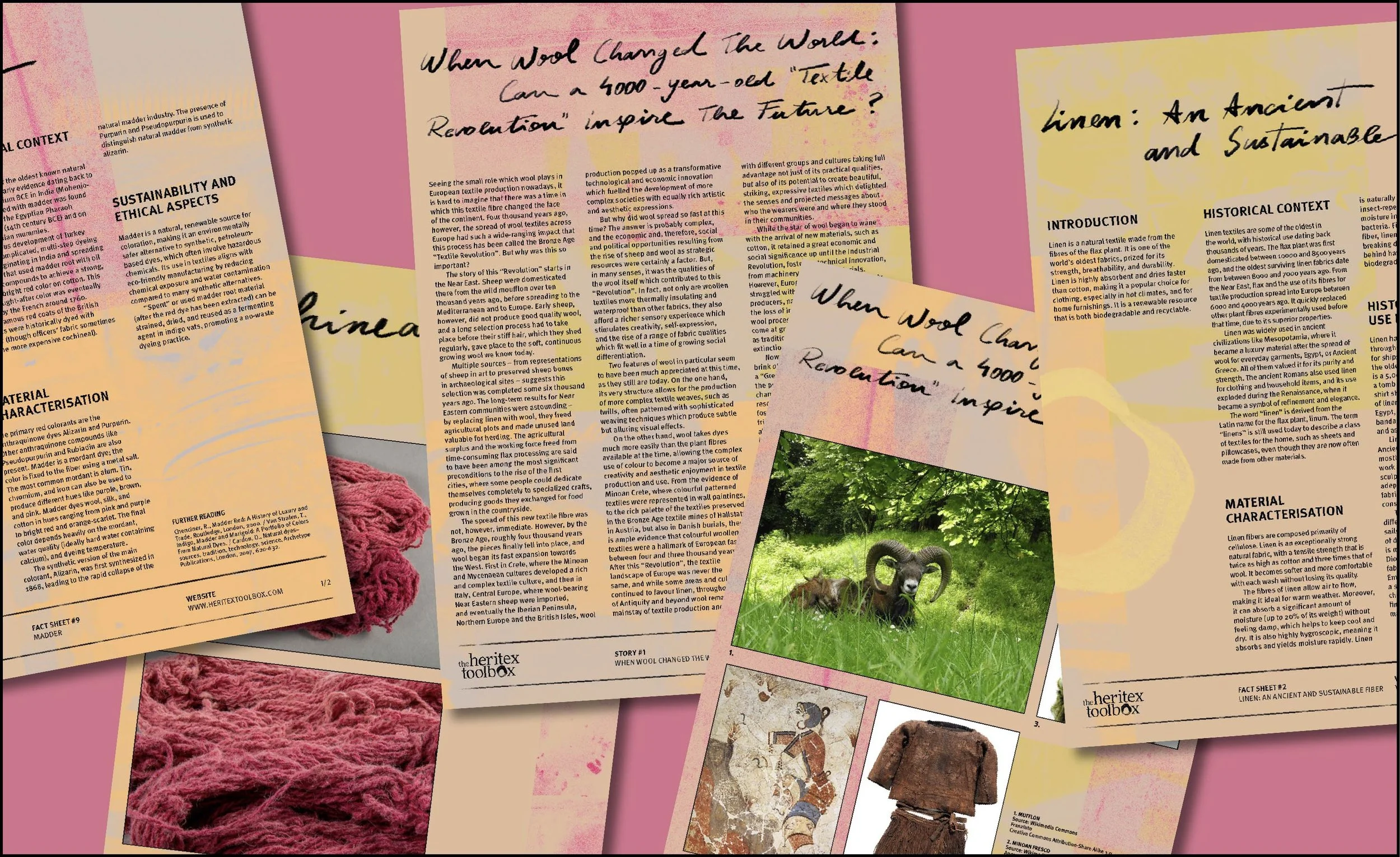
Whether you are looking for facts to help you choose a new material for your creations and products or searching for a meaningful story to inspire you in your pursuit of sustainability and beauty, the HERITEX-HUB Fact Sheets and Storyboards are here to help you. Dive into insightful material profiles and seldom told stories of Textile Heritage and connect with History and tradition while building a better future.
FACT-SHEETS
-
Wool is a natural protein fiber obtained primarily from sheep, but also from other animals such as goats (cashmere, mohair), llamas, alpacas, and rabbits (angora). Renowned for its warmth, durability, and versatility, wool has been a staple material for humanity for millennia. Its unique crimped structure gives it excellent insulation, breathability, and resilience, making it suitable for a wide range of applications.
DOWNLOAD THE FACT SHEET » -
Linen is a natural textile made from the fibres of the flax plant. It is one of the world's oldest fabrics, prized for its strength, breathability, and durability. Linen is highly absorbent and dries faster than cotton, making it a popular choice for clothing, especially in hot climates, and for home furnishings. It is a renewable resource that is both biodegradable and recyclable.
DOWNLOAD THE FACT SHEET >> -
Silk is a natural protein fiber produced by certain insect larvae, most notably the silkworm species Bombyx mori. The lustrous sheen and smooth texture of silk have made it a highly sought-after luxury textile for millennia. It is celebrated for its strength, softness, and natural sheen.
DOWNLOAD THE FACT SHEET >> -
Hemp is a variety of the Cannabis sativa plant cultivated specifically for industrial and consumable use. It is one of the fastest-growing plants on Earth and was one of the first plants to be spun into usable fibre over 10,000 years ago. Hemp can be refined into a wide range of products, including paper, rope, textiles, clothing, biodegradable plastics, and food.
DOWNLOAD THE FACT SHEET >> -
Cotton is a natural textile fibre obtained from the seed hairs of plants in the genus Gossypium. It is one of the most widely used fibres in the world, valued for its softness, breathability, and versatility. Cotton is highly absorbent, comfortable against the skin, and suitable for a wide range of textiles, from clothing to medical supplies and home furnishings. As a plant-based fibre, cotton is renewable and biodegradable, although its environmental footprint depends significantly on cultivation and processing methods.
DOWNLOAD THE FACT SHEET >> -
Willow refers to a group of deciduous trees and shrubs belonging to the genus Salix. Known for its long, slender, and highly flexible branches, willow has been used for thousands of years in basketry, construction, tools, and everyday objects. Willow rods are lightweight yet strong, easily shaped when freshly cut or soaked, and highly renewable due to the plant’s rapid growth and ability to regenerate from cut stems. These properties have made willow one of the most important plant materials in traditional craft practices across Europe, Asia, and North America.
DOWNLOAD THE FACT SHEET >> -
Linden refers to trees of the genus Tilia. Linden has been valued for centuries for two main materials: its soft, fine‑grained wood, ideal for carving and sculpture, and its inner bark (bast), used historically for cordage, mats, baskets, and other textiles or textile‑like structures. Lightweight, workable, and widespread across temperate regions of Europe, Asia, and North America, linden has played a significant role in artistic production, vernacular crafts, and everyday life. As a deciduous tree, linden is renewable and biodegradable, and when responsibly managed, it is considered a sustainable material.
DOWNLOAD THE FACT SHEET >> -
Cochineal is the common name of the American domestic insects, Dacylopius coccus (Costa, 1835), living on cacti of the Opuntus specia and having a long history of being used for dyeing. In a larger sense, the term cochineal was also used for wild American insects from the same genus or for other carminic acid containing insects, from the European and Asian species Porphyrophora. The information given below is with reference to the American domestic insects, also called Mexican cochineal, which are commercially available and may represent a valuable source of colour for all those interested in natural dyeing.
DOWNLOAD THE FACT SHEET >> -
Docks and buckthorns are plants from the Rumex and Rhamnus species with a long history of being used for dyeing, due to the anthraquinones which are present in their bark or roots. In the context of their use as natural dyes, they are generally discussed together, as they contain the same dyes, emodin and chrysophanol (also called chrysophanic acid).
DOWNLOAD THE FACT SHEET >>
-
Dyer’s broom (or dyer’s greenweed) is the common name of Genista tinctoria L., a shrub up to 200 cm high, which can be found in heathlands, grasslands, open woodlands and old meadowsk in most parts of Europe. It is now cultivated in France by Critt Horticole, and in other places in Europe, in botanical and heritage gardens, or by artisans in their gardens. The beautiful yellow flowering branches, which bloom from June to August, have a long history of being used for dyeing.
DOWNLOAD THE FACT SHEET >> -
Indigo is one of the oldest known natural dyes, famous for producing a clear, deep blue hue. Its name originates from the Greek term 'indikon', meaning 'the Indian' or 'from India'. Natural indigo is primarily obtained from the leaves of various plant species in tropical and subtropical regions worldwide, the most widely used being Indigofera tinctoria (True Indigo). Due to the inability to grow Indigofera spp. in cooler climates, the chemically identical dye was also derived from the woad plant (Isatis tinctoria) in Europe for centuries. Today, much of the indigo used commercially is synthetic, a process first patented in 1897.
DOWNLOAD THE FACT SHEET >> -
Poplar bark derives from trees of the genus Populus, fast‑growing deciduous trees common across Europe, Asia, and North America. While poplar is better known for its timber, its inner bark (phloem layer) has historically formed part of the wider tradition of using tree bast for fibre production, cordage, and textile‑related applications. Poplar bark, like that of other Salicaceae trees, contains phenolic compounds, including tannins and salicylate derivatives, which are relevant for dyeing and medicinal uses. As a plant‑based material, poplar bark is renewable and biodegradable when harvested sustainably.
DOWNLOAD THE FACT SHEET >> -
Madder is the common name for plants in the genus Rubia, which are one of the oldest and most important natural sources of red dye. The most widely used species is Common Madder (Rubia tinctorum), also known as Dyer's Madder. The dye is extracted from the thick, fleshy roots of the plant. The term Rubium itself comes from the Latin word ruber, meaning 'red'. Madder has been used since ancient times in Asia, Africa, and Europe.
DOWNLOAD THE FACT SHEET >> -
Avignon or Persian berries is the name used for the fruits of Rhamnus buckthorn, also called dyer’s or rock buckthorns. The fruits come from various Rhamnus species, such as R. saxatilis Jacq., R. lycioides L. or R. catharctica, and are spiny, extensively branched shrubs, up to 2m high. Buckthorns are native from the near East and have been cultivated in Europe since Roman times. R. saxatilis Jacq. and R. lycioides L. grow in rocky places and calcareous soils in the Mediterranean area, while R. catharctica, common in most of Europe, prefers well-drained soils in woodlands, hedgerows or scrublands. The immature fruits of these species, fresh or dried, collected from mid-July to mid-August, are used for dyeing.
DOWNLOAD THE FACT SHEET >> -
Redwood is the common name used to describe the small trees from the Caesalpinia and Haematoxylonum species, which contain in their heartwoods a dye called brazilin. During the Middle Ages, sappanwood (Caesalpinia sappan L.) was imported on a large scale in Europe, from India and southeast Asia.
DOWNLOAD THE FACT SHEET >> -
Sawwort is the common name of Serratula tinctoria L., a plant which could grow up to 150cm high, and is common in meadows, heaths and woods in almost all parts of Europe. It is rare in the Mediterranean plain areas. Sawwort was always considered as an excellent source of yellow, an alternative to the very popular weld (Reseda luteola L.). The plants roots are perennial but the aerial plant dies in the winter.
DOWNLOAD THE FACT SHEET >> -
Weld is the common name of Reseda luteola L., an annual or biennial herb, which could grow up to 130cm tall, and was maybe the most valuable source of yellow dyes in the past. It still grows wild or semiwild in Europe, on roadsides, field margins, old ruins or railway embankments, especially in those areas where it was once cultivated. It is common in France, Italy, Spain, Germany and part of the UK and part of the Balkans. In the last years, there is an increasing interest of growing weld to be used as dye source.
DOWNLOAD THE FACT SHEET >> -
Young fustic (also called Venetian sumac, smoke tree or dyer’s sumacs) is the common name of Cotinus coggygria Scop., a shrub, which could grow up to 5m in high and was one of the most valuable sources of yellow in the Middle Ages. Native in dry, rocky, calcareous hillsides in the Mediterranean regions, it could be also found wild or naturalized in southern, eastern and central Europe. The heartwood, chipped into pieces to allow a better extraction of the dyes, could be harvested from autumn to spring.
DOWNLOAD THE FACT SHEET >>
STORIES
-
Seeing the small role which wool plays in European textile production nowadays, it is hard to imagine that there was a time in which this textile fibre changed the face of the continent. Four thousand years ago, however, the spread of wool textiles across Europe had such a wide-ranging impact that this process has been called the Bronze Age “Textile Revolution”. But why was this so important?
DOWNLOAD THE STORY >> -
Archaeological research has only recently begun to probe the deep history of clothing. The study of stone tools suggests that long before our species even appeared, our Hominid ancestors were already manipulating skins and fur to protect themselves from the elements. Some 45000 years ago, during the last Ice Age, the next step in this evolution take place: new tools – namely needles – appear across Eurasia which suggest that complex garments made of cut and sown skins and furs began to be used, perhaps as a further response to a decrease in global temperatures.
DOWNLOAD THE STORY >> -
In August (or perhaps October) of 79 CE, a rumbling shook the idyllic landscape of the Bay of Naples, in what is nowadays Italy. Mount Vesuvius, a major volcano which had loomed more or less quietly over the communities which had been living in the area for some 800 years, went into a sudden and violent eruption. Caught by surprise, most of the inhabitants quickly fled their homes, while hundreds, if not thousands, stayed behind. It is impossible to say whether those who fled knew that they would never be able to go back to their homes.
DOWNLOAD THE STORY >>

A REPOSITORY OF TEXTILE-INSPIRED STORIES TO INSPIRE AND INFORM
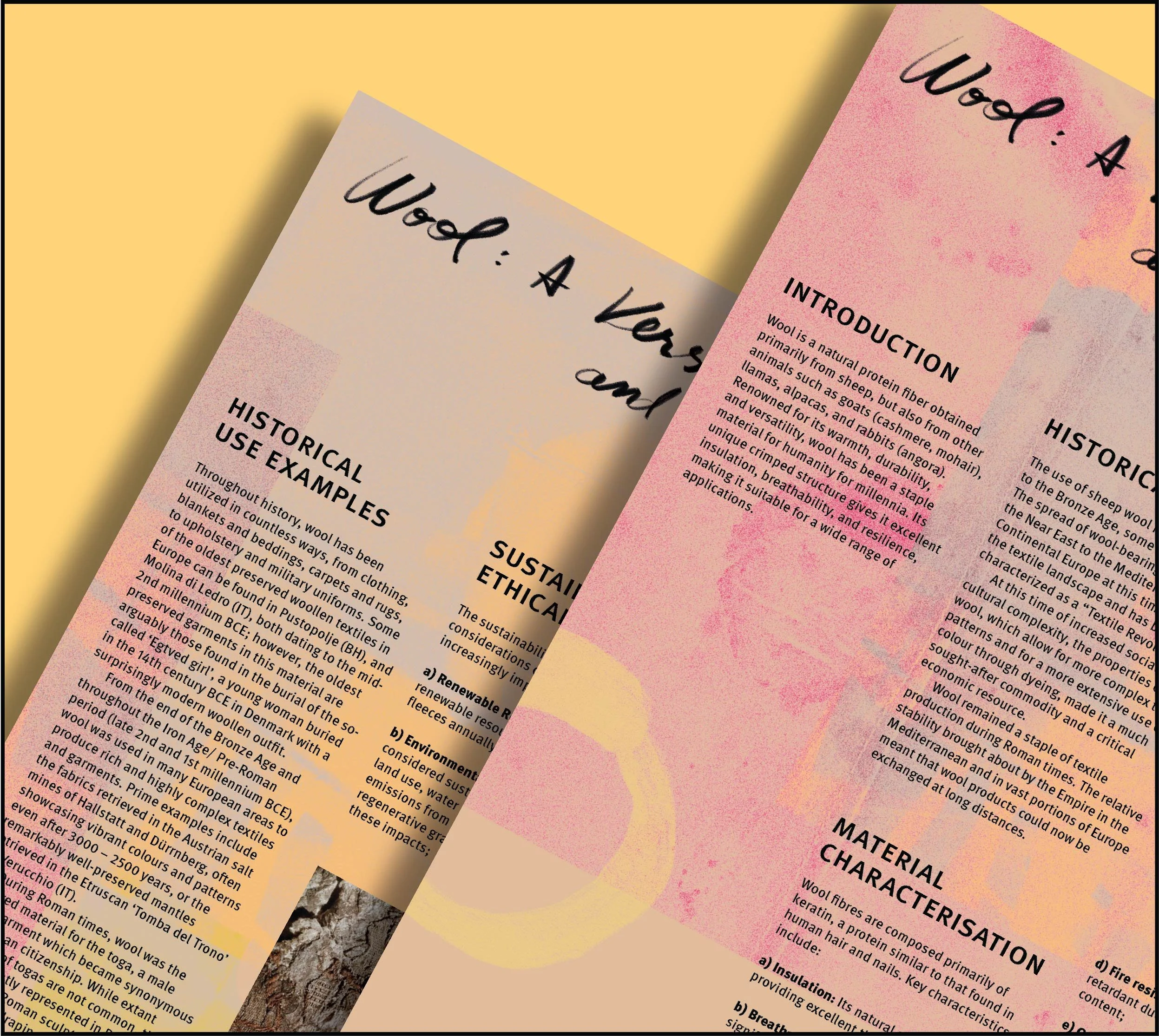
The HERITEX-HUB Toolbox E-book allows you to download the best of the HERITEX-HUB Fact Sheets and Storyboards and bring them with you wherever you go. This compilation of insightful and inspiring facts and stories from Textile Heritage were designed as a resource to spark your creativity and develop your sustainable business ideas. Read up, but do not forget – this is just the start! Find the material that speaks to you, and the story you connect with, and then explore them with the help of our experts and find how to apply it to your business. With HERITEX-HUB, you can harness the power of the Past to make your products sustainable, meaningful and culturally grounded.


HERITEX-HUB is a project powered by COST – European Cooperation in Science and Technology aimed at harnessing the knowledge of Textile Heritage research to foster a more sustainable textile and fashion industry. It aims to build a networked knowledge hub connecting researchers and experts in this field with businesses and entrepreneurs to inspire new creations and new collaborations. Its goal is to support green business models and products inspired by the practices and experiences of the Past, updated as resources for the Present and the Future.